Reading Temperature Specs: Uniformity vs. Stability vs. Accuracy
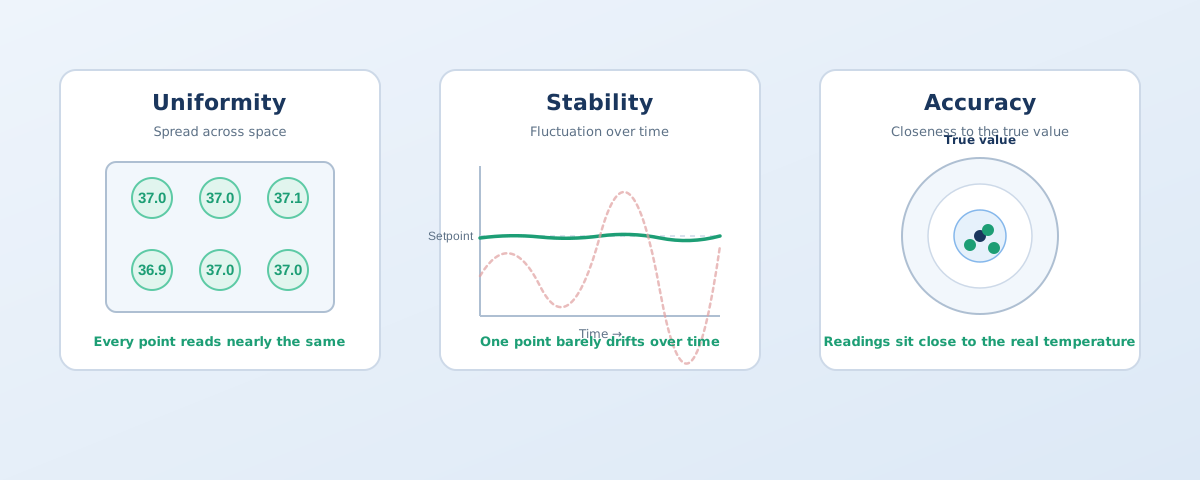
Temperature uniformity, stability and accuracy are three different metrics that buyers most often confuse: uniformity is the spread across points at one moment (spatial); stability is the fluctuation at one point over time (temporal); accuracy is how close the reading is to the true value. Before choosing equipment, identify which one your application truly cares about.
Three easily confused terms
- Uniformity: the maximum spread between points in the working zone at one moment. Larger volumes are harder to keep uniform.
- Stability: the fluctuation at a single point over time, reflecting the control system's capability.
- Accuracy: how close the measured or set temperature is to the true value, verified against a traceable standard.
Which metric matters for which use
- Plasma thawing and warming cabinets: prioritize uniformity to avoid local hot or cold spots.
- Blackbody sources and calibration baths: prioritize stability and accuracy — a reference must be both steady and true.
- Platelet storage: both uniformity and stability matter, and must hold over long periods.
Reading the numbers on a spec sheet
- A ‘display accuracy ±0.1°C’ is display resolution, not measurement accuracy; true accuracy comes from the calibration report and uncertainty.
- If a spec lists stability but not uniformity, be especially careful with large-volume equipment.
- All specs are only meaningful when traceable (see also: temperature traceability and calibration certificates).
Related Products
- Blood Plasma Thawing System BBW-6000 →
- Low-Temperature High-Uniformity Blackbody 360 →
- Temperature Traceability & Calibration Certificates →
FAQ
Uniformity vs. stability?
Uniformity is the spread across positions at one time (spatial); stability is the fluctuation at one position over time (temporal).
Does display accuracy ±0.1°C mean it measures accurately?
No. ±0.1°C is usually display resolution; true measurement accuracy depends on a traceable calibration report and uncertainty.
What if uniformity isn't listed?
The equipment may not emphasize it; for large-volume use, ask for uniformity data so local differences don't affect results.